Summer skin smoothie

The weather over the last few days has been beautifully sunny and warm, the perfect temperature for enjoying summer food offerings like this gorgeous pink watermelon that I ordered with my veg box last week.
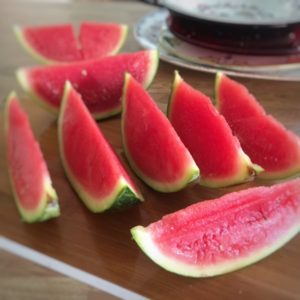
I always associate watermelon with hot weather; maybe it’s just because I ate so much when we were in India! 92% water, it’s really rehydrating on a steamy hot day. The fantastic nutrients found in its gorgeously crisp flesh help to minimise the damage caused by too much sun, as getting the right amount for us Brits is a tricky thing!

The majority of vitamin D that circulates in the body is created through the skin being exposed to sunshine. Vitamin D is not only essential for strong bones and teeth, but also supports the immune system and low levels can lead to a whole array of health problems ranging from asthma to multiple sclerosis. So we really need to get outside and catch some rays. Too much sunshine though can lead to skin damage and potentially skin cancer.

Our weather in the UK is so unpredictable getting regular sun exposure can be difficult. So when the sun does come out, it’s tempting  to expose lily white skin a bit too long and burn – that’s where the damage occurs. Fortunately, food like watermelon can help.

As well as rehydrating the skin, watermelon is packed with vitamin C and betacarotene that act as anti-oxidants, mopping up damaging free radicals created by the damaging rays. It also has large amounts of lycopene that also helps reduce inflammation and can help protect the skin from lasting damage – marvellous!

Apart from just eating it as a chunk, watermelon is delicious in salad (see this old blog post http://thesensitivefoodiekitchen.com/wonderful-watermelon/) and also works as a fantastic base to green smoothies, making it completely dairy free and plant based.

To add in some extra anti-inflammatory power (as well as awesome flavour) I’ve blended ginger and turmeric into this spinach and watermelon smoothie, and added a good squeeze of lime to help absorption of the vitamin C.

Both ginger and turmeric have amazing medicinal properties. Ginger is thought to help with digestive issues, reduce pain from muscle soreness to arthritis to migraine and also help stabilise blood sugars. Turmeric is being hailed as a wonder spice, a surprise to the western world but not to anyone hailing from India where it’s amazing properties have been used for thousands of years. It’s not only anti-septic but also helps reduce all sorts of inflammation in the body. There is so much to say about turmeric it needs it’s own blog post (and more!) but for now it’s a good idea to include some in your diet every day.

So as we bask in possibly the last of the summer sun, why not try this super healthy smoothie and give your skin a super summer treat.

Summer skin soother smoothie
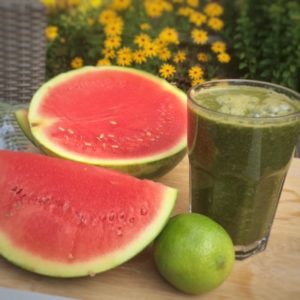
A couple of handfuls of spinach leaves, washed and roughly chopped
1 quarter chunk watermelon (from a small one) chopped
2 cm chunk fresh ginger chopped
1/4-1/2 teaspoon ground turmeric or 1 cm chunk of fresh turmeric chopped
juice of 1 lime

Place all the ingredients into a high speed blender and blend until smooth. Drink straight away.

Tomato power!

Natural food products are constantly under investigation by scientists – and often the large corporations that fund them – to find the next superfood, the key to health or a particular chemical that can be claimed to be discovered and then patented. One of the latest studies to hit the headlines is about tomatoes, or rather the lycopene found in them. Published in Neurology magazine this month (the abstract can be found at http://www.neurology.org/content/79/15/1540.abstract if you’re interested!), a group of scientists in Finland monitored over 1000 men for 12 years and found the risk of stroke was cut by 55% in those with the highest blood levels of lycopene.  That’s pretty impressive!
Lycopene has already been heralded as a hero with evidence that it can help prevent or slow the growth of certain cancers, particularly prostate cancer. There are even tomatoes that have been bred to have double the amount of lycopene, and no doubt sold at a premium price! (http://news.bbc.co.uk/2/hi/health/4896026.stm).

Lycopene is a carotenoid, a phytochemical that gives the red pigment to some fruits and vegetables such as tomatoes, watermelon, red bell peppers and papaya, but sadly not strawberries or cherries! It’s a powerful antioxidant that soaks up free radicals roaming around the body. These great anti oxidant properties have been connected to improving conditions such as heart disease, cancer, diabetes, osteoporosis and now stroke. Free radicals are also associated with the ageing process, so hopefully if they are mopped up by lycopene, youthful skin will follow (maybe!).

The percentage of lycopene in red fruit and vegetables increases as it ripens. In fact, the lycopene content of tomatoes has been shown to increase and become more bioavailable when processed. This includes tinned tomatoes and manufactured tomato products such as pasta sauce and ketchup. This is great for food companies, some of whom are sponsoring ongoing research into the beneficial effects of ketchup. Unfortunately, from a purely nutritional point of view, this causes some other problems; the tinning process increases the sodium content of tomatoes and most sauces and ketchups have lots of added sugar, salt and preservatives, so not so good for overall health. And of course the supplement industry has seen an opportunity and you can buy lycopene tablets, but are these really necessary?

Tomatoes as a whole food contain lots of other goodies including potassium and vitamin C which tend to be lost when processed and heated, along with B vitamins, beta-carotene (the precursor to vitamin A) and of course has fibre and no cholesterol, all good reasons to eat them in their natural form, a fantastic whole food in a healthy diet.

Personally, I love to roast tomatoes with onion, a little olive oil and some garlic, then when cooked blitz them all together and reheat either as a sauce or add some vegetable stock to make a delicious tomato soup. When we first came to India, it was quite hard to find tinned tomatoes or tomato sauces that were suitable for someone with food intolerance – milk turns up in the strangest of things! So I had to get used to using the real thing, and found this to be the best way – the roasting concentrates the flavour and the blitzing increases the bioavailability of the lycopene without adding lots of nasty extras.

watermelon
Wonderful watermelon

Interestingly, watermelon contains more lycopene than tomatoes, but also a higher water content, so you would need to eat a larger amount. It’s not as easily available in the west as tomatoes though, although over here in India, it so easy to find – and cheap – and works great as a base for smoothies.
Of course, the real message in this latest research is that fruit and vegetables are good for us! Eating a full range of produce provides us with all the nutrients we need to stay healthy – as long as they are in their wholefood form. If we only ate red pigmented vegetables then not only would we miss out on all the other antioxidants and nutrients available, in the long run the pigment could become concentrated in our skin and as much as I love tomatoes, I don’t really want to look like one!

Interesting tomato fact (well I found it interesting!!)
Apparently, a whole tomato has no flavour; that only comes by biting, cutting or cooking it. Carefully extracted tomato liquid has no taste. Biting into the fruit releases an enzyme that breaks down larger molecules into smaller ones and gives it the flavour. This enzyme reacts differently when cut crossways, so they will have more flavour sliced.

Green gunge – but it’s good for you!!!

One of my dear friends recently lost loads of weight by following a juicing diet. I was sceptical at first –  how couldjust drinking juice be good for you. It may be full of vitamins and minerals, but what about the fibre and surely you get too hungry (I like my food fairly solid!) and end up bingeing? But she practically glowed with good health as she dropped 2 dress sizes, so there must be something to it.

Health, whether good or bad, comes from the food we put in to our bodies. Juicing provides extra shots of vital goodies to help our bodies deal with the constant stresses and toxins we are exposed to, both external and internal, although I believe in the long run it’s best to eat the whole food rather than just the juicy parts. But if you want to know more about juicing, including some great recipes and tips on when to drink them, check out this article on the Health Ambition website –https://www.healthambition.com/juicing-recipes-for-weight-loss/.

Our bodies know what we need if we learn to listen to it. Since living in India, I have craved green leaves which must mean I’m low in B vitamins, iron or calcium (not sure which) and have even been known to stir fry cauliflower leaves that are usually discarded just because green leaves are hard to come by. On my recent trip to Kashmir, I came across hak which is grown locally in Srinigar. It’s similar to kale and I couldn’t get enough of it and begged the hotel to serve it to me at every meal, it was so gorgeous. It was sautéed in water along with mustard oil, Kashmiri red chilli, salt and a little local masala, or seasoning. Occasionally a little spicy, it’s deep rich green flavours were just divine!

After attending a healthy eating cooking seminar a few months ago, I discovered green smoothies. Made up of 60% fruit and 40% green leaves, they really are quite delicious and leave you feeling revitalised and full of energy – that’s after you’ve managed to get your head around the fact that the green gunge in the glass is actually something you want to ingest! Spinach is pretty easy to come by here; the little organic grocers stocks some beautifully green bunches, leaves not too big. It tastes pretty strong, much more so than the lovely baby leaves you can by in the supermarkets in the UK, so it’s green hard core from the off. Called palak, it’s not traditionally eaten raw here – my maid was horrified to find out I ate uncooked leaves, and surprised to find out I lived to tell the tale!

Green smoothies can be made with any green leaf as it’s base – spinach, celery or beetroot tops even mint. The key is to vary your intake and not have them every day – raw green leaves contain oxalic acid. Consuming large amounts of oxalic acid can be toxic (you would need a lot of greens every day for this to happen). It binds to metals, such as iron, making it unavailable for absorption in to the body. This therefore means that spinach isn’t a great source of iron in the diet, despite what Popeye might say. However, vitamin C enhances iron absorption, so matching spinach with lemon for example counteracts the negative effects of oxalic acid. And green leaves are an amazing source of vitamin B, calcium and magnesium to name a few.

I’ve featured my favourite green smoothie combination, but you can make up whatever you like. Grind the green leaves in the blender first before adding the other ingredients as the cellulose in the cell walls takes some time to break down.

Spinach, watermelon and banana smoothie
Handful of spinach leaves, thoroughly washed
Big chunk of watermelon
2 small ripe bananas or 1 medium
juice of sweet lime
flaxseed powder (if you want an omega 3 shot).
Place the spinach in the blender and blast on full power until the leaves are broken and mushy. Add in the fruit and juice and blast again until everything is incorporated and fluid – this may take up to 2 minutes depending on the speed of your blender. Sprinkle in flaxseed powder if you are using it and whizz again for a moment. Poor into a glass, close your eyes and deceive your brain as you knock it back. I managed to get my son to try it despite his dubious face – he actually admitted it tasted good but preferred his fresh pineapple juice as it looked more normal!