10 a day. Really?

A couple of weeks ago, it was reported that eating 10 portions of fruit and vegetables a day significantly reduced the risk of death from the main killers of our time – heart disease, stroke and cancer (http://tinyurl.com/hpb4ctl)

This is really good news! However, many may feel like Munch’s ‘Scream’ – not more veggies to have to force down during the day! The Department of Health adopted the 5 a day campaign in 2003. If you are horrified at the thought of having to eat more, you’re not alone – studies indicate that only 25% of men and 28% of women in the UK hit that target and that on average children eat only 3 portions a day.

You may have noticed that here in The Sensitive Foodie Kitchen, we’re a bit partial to the old fruit and veg! Most my recipes have plants snuck in some way, even in the cakes! That’s mainly because they taste awesome, but also because they really do help to heal and to maintain health due to their array of amazing nutrients. It’s this benefit that the research is focused on – a detailed analysis of 95 separate studies that covered up to 2 million people revealed that the more fresh fruit and vegetables eaten, the lower the death rate from chronic disease. Eating even a small amount makes a difference, so really anything is better than nothing, but 10 is the magic number they came to when it comes to maxing out the benefits.

Before you reluctantly fish out 10 portions of carrots to munch through every day, think again. Not only would that be really boring and potentially not very good for you, it’s 10 different types of fruit and veg that’s needed. Variety really is the key. That’s why I always recommend eating a rainbow every day. Not only is it pleasing to the eye, but your body will love it too as you will receive the full range of micronutrients and phytonutrients it so loves. And if you have food sensitivities and intolerances, it’s a great way to help your gut and your body heal (as long as you avoid the item/s that are upsetting you!).

So is 10 portions a day realistic? Getting more lovely plant based produce into the diet is one of the things we cover on my Eat Well Live Well course where I show you how to do it, plus give you a whole selection of recipes to keep you interested and motivated. So I can definitely confirm it is – with a little bit of forward planning and focus. The three main things to do is:

  • have a bowl of fresh vegetable soup every day
  • eat a salad every day
  • eat a good portion of cooked vegetables every day

Just doing these three simple things will wack up your veggie intake alone. Add in a 2-3 portions of fruit a day and you’re there.

Never expecting anyone to do anything I wouldn’t, here is a run down of what I ate today – lets see if I managed to get to 10:

Breakfast – fruit and nut muesli with almond milk, ground flaxseed, a portion of blueberries (1) and a banana (2)
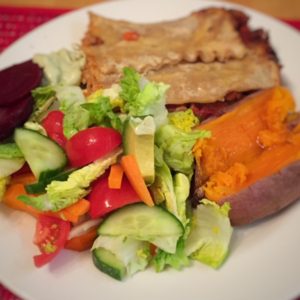
Lunch – vegetable and lentil soup (3&4) with a hummus wrap and salad (5).

Snack – apple (6)

Dinner – vegetable lasagna – dairy free and gluten free, of course (7), baked sweet potato (8) with salad (9&10) and fruit crumble (11).

Done! And that’s why I always recommend a whole food plant based diet – it’s easy to reach this target and eat fabulous food in the process.

So why not have a look at what you eat each day, and if you’re slightly off track, look at making some simple additions to get great benefits. And if you feel you need more, why not come along to my next course starting on 25th April in Hove – follow the link for more information http://thesensitivefoodiekitchen.com/5-week-course-2/

Happy munching!


Original kedgeree

Every now and then my husband gets the urge to have a session in the kitchen. Apart from the inevitable mess, I love it when he’s inspired to try out something different – not only does it give me the night off, but it’s usually something he’s been thinking about for a while and researched within an inch of it’s life. Big contrast to my sudden inspiration, throwing things together to see what happens approach!

He’s been mainly plant based for over a year and a half now which is quite a surprise to both of us! Having gone for it, he’s quite happy not to go back eating to meat and dairy for now as it stops him from pigging out on pastries and burgers. There are a few things he misses though (thankfully beer is plant based). Oddly, one is kedgeree, something we rarely ate but obviously on his list of ‘foods I love’. So he decided to get researching to make a completely plant based version.

It didn’t take him long to discover the original version of kedgeree – kichiri, a simple Indian comfort food, traditionally given to those under the weather. Legend has it that kedgeree, which includes milk, fish and egg, was devised by Colonial Brits in India, then brought back to England, although according to Wikipedia, there is some contention that it appeared in Scotland in the 1700’s; the India connection remains intact though. When exactly a fish, rice and egg combo became a breakfast dish, I’m not so sure.

Kichiri is the perfectly balanced plant based dish. A mixture of rice, lentils and some super spices, it’s tasty, satisfying and remarkably moreish despite the simplicity. The lentils give it a little bit of texture and it’s aromatic rather than spiciness, so gentler on the palate.

Rice and lentils create the perfect plant based protein – both these lovelies contain the full range of essential amino acids. Even though it’s one of the top arguments detractors will come up with when you decide to go plant based, there’s no fear about missing out on protein as long as you eat a wide range of products. And of course wholegrain is best as more nutrients are retained. And lentils give you much more than just protein – they also have a wonderful dollop of fibre, manganese, iron and B vitamins amongst others.

A cucumber raita completes this dish perfectly – using dairy free yoghurt of course! You could get flashy and add make a little spicy tempering to go on the top – toasted cumin and mustard seeds with a couple of dried red chillis and some fresh curry leaves to finish. Lovely.

So why not give this a go and see what you think – is definitely different to kedgeree but still comfortably familiar!

Kichiri (serves 4)
160g green lentils
270g wholegrain basmati rice
1 teaspoon cumin seeds
1 teaspoon black mustard seeds
1 onion, diced
1 inch piece fresh ginger, grated
2 cloves garlic finely chopped
1 carrot, diced
1 red pepper, diced
1 teaspoon ground coriander
1/4 teaspoon turmeric
pinch of salt
1 litre water
couple of handfuls fresh coriander
Heat a glug of olive oil in a large pan and sauté the cumin and black mustard seeds until they start to pop. Add the onion and ginger and cook for a couple of minutes, stirring so it doesn’t burn. Add the carrot and red pepper and cook for another minute or so, then add the garlic, rice and lentils as well as the ground coriander, turmeric and salt and cook on a low heat stirring all the time. After a minute or so, carefully pour in the water, bring to the boil and pop on the lid. Turn the heat down low and cook for 15-20 minutes until the water has been absorbed and the lentils are tender. Turn off the heat, and leave to steam for a couple of minutes.
Season to taste with salt and pepper. Sprinkle fresh coriander over the top to serve. Enjoy!

Steve’s Saturday night squash curry

As much as I love cooking, it’s always a treat when someone else does it for a change. Because of work and travel commitments, my hubby Steve doesn’t get many opportunities to get creative in the kitchen, so when he offers to cook it’s always a treat, especially as I was out all day yesterday, so it was a real relief to come home and be served with a piping hot dinner.

Steve does what I call ‘man’s cooking’ – lots of ingredients all prepped before hand (often with lots of washing up!), loud music and always a beer on the go. Not that this is a criticism, just a little observation – whatever is needed to maximise the cooking experience (although the number of beers could potentially be directly linked to the outcome of the dish – “hic!”).

Having lived in India and spent time in South Africa, Steve has picked up a few tricks and makes a mean veggie curry, all dairy free of course. Aware of my veg box blogging challenge, he did check what I had planned to make – a sweet mama squash and chickpea curry – so now I’m writing about his version of what I had planned in my head!

Squash and chickpeas go together really well in terms of flavour, texture and nutrition. I’ve already talked about what nutritional powerhouses they are (Thursday stuffed squash and Friday’s pancakes), as well as fabulous sources of fibre that your gut will love. They also both work wonderfully with spices, and complement each other superbly.

Of course, spices add more than just colour and flavour to a dish; they contain amazing healing properties that have been used for thousands of years, but science is only just beginning to understand how.

Cumin, for example Turmeric has long been used for it’s anti-inflammatory and anti-septic properties, but the active ingredient – curcumin – has only recently been identified and researched. It seems that the amazing properties in turmeric can help relieve all sorts of ailments from period problems, to IBS, to joint pain to cancer. In fact, there is so much to say about turmeric, there’s no way enough room here, so let’s just say it’s amazing and should be included in your diet as much as possible!

Steve likes the base of his curry sauces to cook down over a period of time to concentrate the flavours; this doesn’t take that much longer, but really does deepen the flavour.

There are a couple of interloper ingredients again, but from the veg box he used an onion, two of the carrots and the second half of the sweet mama squash. There was (and still is!) loads, so this recipe feeds a hungry crew easily.

Play around with the spices to get the heat level you desire – I’ve only given approximations here, as I’m not really too sure exactly how much was put in! Needless to say, it was super tasty, and all the more special as I didn’t have to cook!

Steve’s Saturday night squash curry
1 onion, chopped
2 cloves garlic, diced
2 cm piece fresh ginger, finely chopped
1-2 red chilli, chopped
3-4 tomatoes, chopped
1 teaspoon ground cumin
1 teaspoon curry powder/garam masala
1/2 teaspoon ground turmeric
water
1/2 sweet mama squash cut into smallish chunks
2 carrots, diced
1 courgette, diced
1/3 small cauliflower, chopped (optional)
400g tin chickpeas, drained and rinsed
salt and pepper
Heat a dash of olive oil in the bottom of a pan and cook the onion for a couple of minutes until soft. Add the garlic, ginger and chill and cook for another couple of minutes, stirring all the time so it doesn’t burn. Stir in the chopped tomatoes and let it cook down for a few minutes. Stir in the spices and add some water to make a thick sauce. Cook down on a low heat, adding a bit more water for 15 minutes or so until the flavours have developed.
Add the squash and carrot chunks, covering them well with the sauce, adding a little more water to almost cover. Pop on a lid, bring to the boil, and simmer for 5 -10 minutes until the veg begin to soften. Add in the courgette, cauliflower and chickpeas and simmer until all the veg are soft and the sauce has thickened up nicely. Season with salt and pepper.
Serve with popadoms and steamed brown rice.

Curry comfort

Our time living in Indian widened our horizons in many ways. Food wise, we discovered a cornucopia of different South Indian ‘curries’ most of which we had never come across before in the UK. Most curry houses in the UK serve North Indian, Bangladeshi or Pakistani routed food, adapted to the British taste (lots of sauce!). These dishes tend to be rich, tomato based, heavy with cream and featuring meat. South Indian food consists of a huge amount of vegetarian dishes, many enhanced with coconut, either milk or freshly ground, making them rich but not heavy.

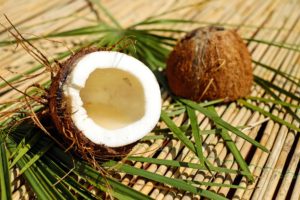
Coconut is a regular ingredient on my blog – I love it, not only for it’s wonderful creamy taste, but it’s amazing health benefits. Coconut meat and milk are high in fat, there’s no getting away from it, but the fat is medium-chain saturated fats which research shows is actually health promoting rather than detrimental like many saturated animal fats. And of course, being plant based, it contains no cholesterol, a fact my friend was surprised about when I told her. Placed on a cholesterol reducing diet by her GP (better than being given statins that’s for sure), it was on the list of food to avoid due to  it’s high cholesterol content. In fact the oil in coconut helps improve a person’s cholesterol, increasing healthy HDL cholesterol.


Lauric acid is one of the main fatty acids in coconut; this converts to other compounds in the body and had an array of beneficial effects including acting as an anti-viral, anti-bacterial and anti-fungal and if eaten as coconut meat, the fibre promotes these properties, contributing to a healthy gut.

I love to make vegetable Malabar curry on a cold and windy day as there’s just something so warming and comforting about it. Rich and flavoursome, I feel wrapped in a soothing warmth. Malabar curries come from the Kerala area, often as a fish curry. Although truly Indian, it has Chinese roots and developed along the coast. The warm, comforting element comes from the inclusion of a mixture of cinnamon, cloves and cardamom, all medicinal herbs in their own right. Cloves have an anti-inflammatory effect as well as a mild anaesthetic (oil of cloves for toothache), cinnamon has compounds that aid digestion and help reduce muscle spasm (amongst other effects) and cardamon is sometimes used as an anti-depressant.

Make this super healthy by using red, orange and green vegetables, packed full of nutrients and anti-oxidants to keep the winter bugs at bay. And of course by using coconut, it’s completely dairy free.
Although there is a long list of ingredients in this recipe, it’s actually pretty easy to make. You can buy a malabar curry mix from your local Indian store, but be careful, as these can contain a large amount of salt. It’s pretty easy to make your own, so I make it fresh each time. Serve this up on a blustery evening with a warm roti or pile of steamed rice (brown of course!) and let yourself be enveloped with a soothing warmth which, with any luck, will transport your mind, if not your body, to warmer climes.

Vegetable Malabar Curry<
Spice mix:2 teaspoons ground cinnamon
2 whole cloves
4 cardamon pods
Vegetable mix:
1 teaspoon olive oil
1/4 teaspoon black mustard seeds
1 spring curry leaves
Asafoetida – pinch (miss if you can’t find it)
1/2 teaspoon turmeric
1 teaspoon chilli powder
1 tablespoon fresh grated ginger
2 onions chopped
2 fresh tomatoes, pureed
1 cup chopped carrot or sweet potato
1 cup green veg (beans, broccoli)
couple of handfuls sweetcorn or peas
1 tin coconut milk
up to 1 cup warm water
fresh coriander to garnish
First, make your spice mix. Bash the cardamon pods in a pestle and mortar to release the seeds. Grind seeds with the cloves until fine and mix in the cinnamon.

Heat the oil in a large pan and cook the mustard seed, asafoetida and curry leaves until the seeds splutter. Add the onion and ginger and cook until the onion is soft. Pour in the pureed tomatoes and a pinch of salt, and cook for 10 minutes. Stir in the chilli powder, turmeric, spice mix, vegetables and mix well to coat. Pour in the water and simmer with the lid on until the vegetables are cooked.
Turn off the heat and pour in the coconut milk. Stir well and heat on a low flame for a few minutes. Season with salt and pepper as needed, sprinkle the fresh coriander over the top, and enjoy