10 a day. Really?

A couple of weeks ago, it was reported that eating 10 portions of fruit and vegetables a day significantly reduced the risk of death from the main killers of our time – heart disease, stroke and cancer (http://tinyurl.com/hpb4ctl)

This is really good news! However, many may feel like Munch’s ‘Scream’ – not more veggies to have to force down during the day! The Department of Health adopted the 5 a day campaign in 2003. If you are horrified at the thought of having to eat more, you’re not alone – studies indicate that only 25% of men and 28% of women in the UK hit that target and that on average children eat only 3 portions a day.

You may have noticed that here in The Sensitive Foodie Kitchen, we’re a bit partial to the old fruit and veg! Most my recipes have plants snuck in some way, even in the cakes! That’s mainly because they taste awesome, but also because they really do help to heal and to maintain health due to their array of amazing nutrients. It’s this benefit that the research is focused on – a detailed analysis of 95 separate studies that covered up to 2 million people revealed that the more fresh fruit and vegetables eaten, the lower the death rate from chronic disease. Eating even a small amount makes a difference, so really anything is better than nothing, but 10 is the magic number they came to when it comes to maxing out the benefits.

Before you reluctantly fish out 10 portions of carrots to munch through every day, think again. Not only would that be really boring and potentially not very good for you, it’s 10 different types of fruit and veg that’s needed. Variety really is the key. That’s why I always recommend eating a rainbow every day. Not only is it pleasing to the eye, but your body will love it too as you will receive the full range of micronutrients and phytonutrients it so loves. And if you have food sensitivities and intolerances, it’s a great way to help your gut and your body heal (as long as you avoid the item/s that are upsetting you!).

So is 10 portions a day realistic? Getting more lovely plant based produce into the diet is one of the things we cover on my Eat Well Live Well course where I show you how to do it, plus give you a whole selection of recipes to keep you interested and motivated. So I can definitely confirm it is – with a little bit of forward planning and focus. The three main things to do is:

  • have a bowl of fresh vegetable soup every day
  • eat a salad every day
  • eat a good portion of cooked vegetables every day

Just doing these three simple things will wack up your veggie intake alone. Add in a 2-3 portions of fruit a day and you’re there.

Never expecting anyone to do anything I wouldn’t, here is a run down of what I ate today – lets see if I managed to get to 10:

Breakfast – fruit and nut muesli with almond milk, ground flaxseed, a portion of blueberries (1) and a banana (2)
Lunch – vegetable and lentil soup (3&4) with a hummus wrap and salad (5).

Snack – apple (6)

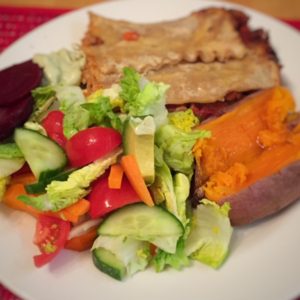
Dinner – vegetable lasagna – dairy free and gluten free, of course (7), baked sweet potato (8) with salad (9&10) and fruit crumble (11).

Done! And that’s why I always recommend a whole food plant based diet – it’s easy to reach this target and eat fabulous food in the process.

So why not have a look at what you eat each day, and if you’re slightly off track, look at making some simple additions to get great benefits. And if you feel you need more, why not come along to my next course starting on 25th April in Hove – follow the link for more information http://thesensitivefoodiekitchen.com/5-week-course-2/

Happy munching!


Vitamin C surprises

Recently, I completed an analysis of the vitamin content of my food over a few days. Eating a wholefood, plant based diet, I thought my intake would be fabulous. For some, like vitamin A and folate, it was amazing, for others, like B12 which is only found in animal products and yeasts, it was non-existent. No real shocks there.

What did surprise me was the vitamin C content. Whilst pretty good, and above the official recommended daily intake (RDI), it was still only moderate in comparison to the levels that are thought to really promote health, 500mg or above.

I don’t want to get bogged down in figures or controversies surrounding vitamin C (as there are quite a few!!), but think there’s a few things worth pointing out. RDIs are established to state the amount of a vitamin or mineral you should have to prevent specific, identifiable diseases. In the case of vitamin C, it’s scurvy, a horrible condition that used to hit sailors out on the high seas for long periods of time without any fresh fruit or vegetables. You don’t actually need much vitamin C to prevent scurvy, so the current recommendation of 40mg/day is higher than absolutely necessary. Which is great, because vitamin C does much more than stop your gums from bleeding.

In the 1970s, research suggested that vitamin C could prevent the common cold; many people still believe this and religiously take vitamin C supplements. In fact, vitamin C is the most commonly purchased food supplement in the UK. However, since then, loads more research as been undertaken which disagrees with Pauling’s original conclusion.

What has been found is that vitamin C is a highly active anti-oxidant. A co-factor for many enzymes, it’s essential for key metabolic functions in the body, including processing fatty acids, controlling blood cholesterol levels and processing drugs and toxins in the liver. Vitamin C is attributed to improving a multitude of common complaints including allergies, arthritis, asthma, eczema, PMT, osteoporosis – the list goes on. Eating processed foods, high in fat and protein, and taking medication for acute and chronic illnesses further exposes our bodies to stress; it seems to me that good doses of vitamin C are essential for everyone!

I want to get my vitamin C from my diet rather than taking pills, so what are the best foods to eat?  Everyone thinks that citrus fruits are the best source and whilst oranges and lemons are pretty well loaded with vitamin C, they are trumped by peppers and greens. I was amazed to discover that the best source by far is peppers – chilli, bell, all sorts and of all colours. This is swiftly followed by those marvellous greens – kale, spring greens, broccoli, watercress, sprouts – again the list can go on. The best fruits are actually blackcurrants and strawberries, which is great at this time of year in the UK, as strawberry season is upon us and I’m in strawberry heaven!! There’s nothing quite like a freshly picked, succulently sweet British strawberry!

By including more of these vitamin C packed foods its pretty easy to increase vitamin C intake – almost triple it. And of course, all fruits and vegetables contain a whole array of vitamins, minerals and phytonutrients that help our bodies not only function more efficiently, but heal from within.

Tomato power!

Natural food products are constantly under investigation by scientists – and often the large corporations that fund them – to find the next superfood, the key to health or a particular chemical that can be claimed to be discovered and then patented. One of the latest studies to hit the headlines is about tomatoes, or rather the lycopene found in them. Published in Neurology magazine this month (the abstract can be found at http://www.neurology.org/content/79/15/1540.abstract if you’re interested!), a group of scientists in Finland monitored over 1000 men for 12 years and found the risk of stroke was cut by 55% in those with the highest blood levels of lycopene.  That’s pretty impressive!
Lycopene has already been heralded as a hero with evidence that it can help prevent or slow the growth of certain cancers, particularly prostate cancer. There are even tomatoes that have been bred to have double the amount of lycopene, and no doubt sold at a premium price! (http://news.bbc.co.uk/2/hi/health/4896026.stm).

Lycopene is a carotenoid, a phytochemical that gives the red pigment to some fruits and vegetables such as tomatoes, watermelon, red bell peppers and papaya, but sadly not strawberries or cherries! It’s a powerful antioxidant that soaks up free radicals roaming around the body. These great anti oxidant properties have been connected to improving conditions such as heart disease, cancer, diabetes, osteoporosis and now stroke. Free radicals are also associated with the ageing process, so hopefully if they are mopped up by lycopene, youthful skin will follow (maybe!).

The percentage of lycopene in red fruit and vegetables increases as it ripens. In fact, the lycopene content of tomatoes has been shown to increase and become more bioavailable when processed. This includes tinned tomatoes and manufactured tomato products such as pasta sauce and ketchup. This is great for food companies, some of whom are sponsoring ongoing research into the beneficial effects of ketchup. Unfortunately, from a purely nutritional point of view, this causes some other problems; the tinning process increases the sodium content of tomatoes and most sauces and ketchups have lots of added sugar, salt and preservatives, so not so good for overall health. And of course the supplement industry has seen an opportunity and you can buy lycopene tablets, but are these really necessary?

Tomatoes as a whole food contain lots of other goodies including potassium and vitamin C which tend to be lost when processed and heated, along with B vitamins, beta-carotene (the precursor to vitamin A) and of course has fibre and no cholesterol, all good reasons to eat them in their natural form, a fantastic whole food in a healthy diet.

Personally, I love to roast tomatoes with onion, a little olive oil and some garlic, then when cooked blitz them all together and reheat either as a sauce or add some vegetable stock to make a delicious tomato soup. When we first came to India, it was quite hard to find tinned tomatoes or tomato sauces that were suitable for someone with food intolerance – milk turns up in the strangest of things! So I had to get used to using the real thing, and found this to be the best way – the roasting concentrates the flavour and the blitzing increases the bioavailability of the lycopene without adding lots of nasty extras.

watermelon
Wonderful watermelon

Interestingly, watermelon contains more lycopene than tomatoes, but also a higher water content, so you would need to eat a larger amount. It’s not as easily available in the west as tomatoes though, although over here in India, it so easy to find – and cheap – and works great as a base for smoothies.
Of course, the real message in this latest research is that fruit and vegetables are good for us! Eating a full range of produce provides us with all the nutrients we need to stay healthy – as long as they are in their wholefood form. If we only ate red pigmented vegetables then not only would we miss out on all the other antioxidants and nutrients available, in the long run the pigment could become concentrated in our skin and as much as I love tomatoes, I don’t really want to look like one!

Interesting tomato fact (well I found it interesting!!)
Apparently, a whole tomato has no flavour; that only comes by biting, cutting or cooking it. Carefully extracted tomato liquid has no taste. Biting into the fruit releases an enzyme that breaks down larger molecules into smaller ones and gives it the flavour. This enzyme reacts differently when cut crossways, so they will have more flavour sliced.